Never Let Hope Become Your Evidence
How one promising client inquiry became a reminder that good business decisions begin with questions, not assumptions.
If you’ve owned a small business for any length of time, you know the feeling that comes with a new inquiry. Someone you’ve never met reaches out and asks about your products or services. Before you’ve even replied, your imagination starts filling in the blanks. You picture the finished project, the invoice being paid, and perhaps even the referrals that might come from a satisfied customer.
That excitement isn’t a weakness—it’s part of what makes entrepreneurs successful. We believe opportunities exist because, most of the time, they do. Every long-term customer was once a stranger who sent an email or made a phone call.
The challenge is knowing when excitement begins influencing our judgment.
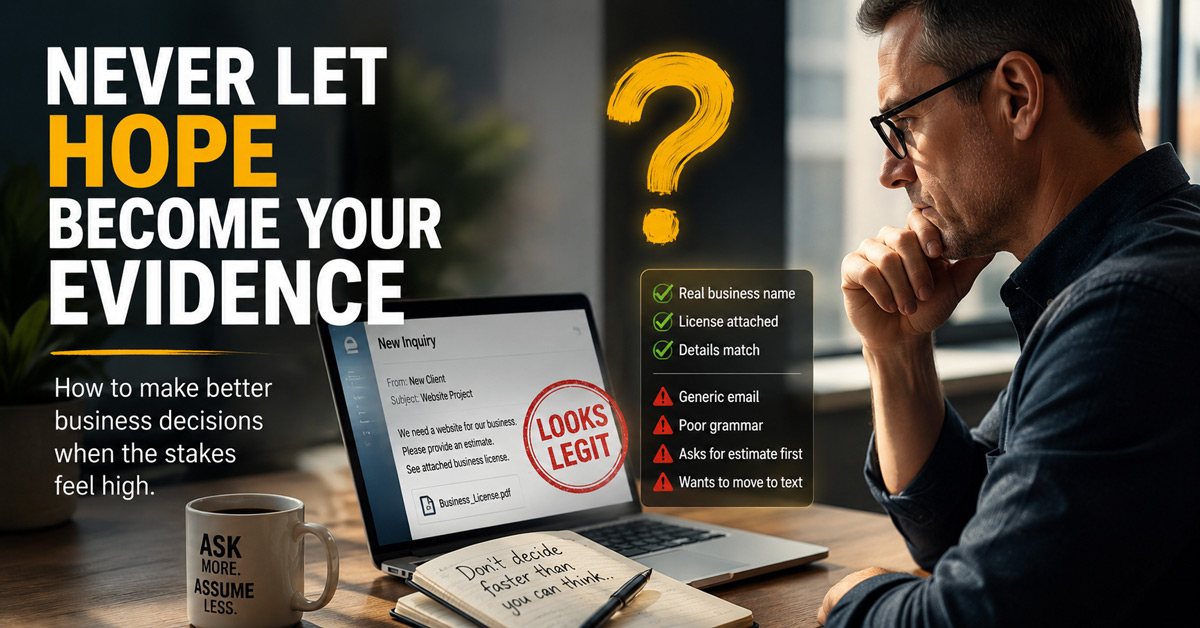
Recently, I received an email from someone who wanted a website for their business. The message was simple. They explained that they wanted a website modeled after another company’s site, said they would provide the content and images, and asked me to prepare an estimate. To reinforce their credibility, they attached documentation that appeared to verify their business.
On the surface, it looked like the kind of opportunity every small business owner hopes to receive.
After more than twenty years in business, however, I’ve learned that first impressions deserve curiosity, not commitment.
A Story With an Unfinished Ending
Before I go any further, it’s important to say something that often gets overlooked in conversations about scams.
I still don’t know whether this inquiry was legitimate.
The business itself appears to exist. Public records confirmed that it had been registered. The documentation attached to the email appeared to match information available through state records. It is entirely possible that the inquiry came from a real business owner looking for a website.
It is also possible that someone was impersonating a legitimate business to gain credibility.
The truth is, I don’t know.
That uncertainty is actually the reason I’m writing this article. Too many people think good decisions require certainty. They don’t. Good decisions require enough trustworthy evidence to justify taking the next step. Those are two very different things.
Looking for Reasons to Believe
Like many business owners, I’ve experienced busy seasons and slow seasons. I know what it’s like to wonder where the next project is coming from, and I know how tempting it is to welcome every new inquiry with open arms.
When we want something to be true, our minds naturally begin looking for evidence that supports our hopes. We notice the encouraging details because they move us closer to the outcome we want. The contradictory details often receive less attention because they interrupt the story we’ve already started telling ourselves.
As I researched the inquiry, there were certainly encouraging signs. The business appeared to exist. The attached documentation appeared authentic. Those facts increased my confidence, and they deserved to be part of the decision-making process.
If I had stopped there, I probably would have begun preparing a proposal.
Fortunately, another question came to mind.
What evidence argues against the conclusion I’m beginning to reach?
That single question changed the entire investigation.
Looking for Reasons to Doubt
I went back and reread the email exchange, this time trying to see it through a different lens.
The sender was using a free email account instead of a company domain. The writing contained awkward grammar and phrasing that reminded me of many questionable inquiries I had received over the years. The sample website link they provided wasn’t formatted correctly. They wanted an estimate almost immediately without spending much time discussing their business, their customers, or their goals. They also wanted to move the conversation to text messaging very early in the process.
None of those details proved the inquiry was fraudulent.
Just as importantly, none of the positive details proved it was legitimate.
That’s the moment when I realized I had been asking the wrong question.
I wasn’t a detective trying to solve a crime.
I was a business owner deciding whether I had enough trustworthy information to invest my time.
Understanding the Playbook
Whether this particular inquiry was legitimate is almost beside the point because the pattern itself is well known.
For years, small business owners—particularly web designers, graphic designers, photographers, printers, and other creative professionals—have received inquiries that follow a remarkably similar script. A prospective client contacts them about a project, often with very little discussion about goals or strategy. The communication feels slightly unusual but not necessarily alarming. The project sounds attractive, the budget appears reasonable, and enough legitimate information is included to lower the recipient’s guard.
The real deception doesn’t usually happen in the first email.
It happens after you’ve emotionally committed to believing you’ve landed a new client.
Once you’ve invested time preparing proposals, answering questions, and imagining the revenue, the conversation changes. Perhaps the client accidentally overpays and asks you to refund the difference. Maybe they ask you to pay a third-party vendor on their behalf because they’re traveling or having banking issues. Sometimes they’ll claim a printer, developer, photographer, or shipping company needs to be paid directly from the funds they’ve already sent you.
The details vary from one scam to another, but the objective is almost always the same: convince you to send real money before you discover the payment you received was fraudulent or will eventually be reversed.
What makes these scams so effective isn’t the technology behind them.
It’s human psychology.
Most of us want to believe people are honest. We don’t like questioning someone’s integrity without evidence, and we certainly don’t want to lose what appears to be a good customer because we’re overly suspicious. Scammers understand that. They know that once you’ve mentally added the project to your calendar and started counting on the income, you’ll naturally look for reasons to keep believing everything is legitimate.
That is why these scams have survived for years.
Not because the criminals are brilliant, but because human nature hasn’t changed.
They don’t attack your computer first.
They attack your judgment.
That realization changed how I viewed the inquiry sitting in my inbox. Whether this sender was legitimate or not, I recognized that the safest response wasn’t to make a quick decision. It was to slow the process down until the evidence—not my optimism—pointed clearly in one direction.
The Decision
Rather than accuse the sender of anything, I chose to slow the conversation down.
I explained that I already had several projects scheduled and wouldn’t be able to begin another website for a couple of weeks. If that timeline worked for them, I would be happy to schedule a conversation to learn more about their business before preparing a proposal.
That response accomplished two things.
First, it protected my time until I gathered more information. Second, it removed the urgency from the conversation. Legitimate business relationships rarely suffer because someone asks thoughtful questions or needs a little time. Scams, on the other hand, often rely on momentum. They depend on people making decisions before they have an opportunity to think critically about what they’re seeing.
Whether this particular inquiry was genuine or not almost became irrelevant.
I had made the correct decision based on the information available to me.
The Lesson Has Nothing to Do With Websites
It’s easy to read a story like this and conclude that it’s about scams.
It isn’t.
This story could just as easily have been about a business partnership, an investment opportunity, a job applicant, a salesperson, or even information generated by artificial intelligence. Every day we are asked to make decisions without having every fact we’d like to possess.
The question isn’t whether uncertainty exists.
The question is how we respond to it.
Some people allow hope to make the decision. Others allow fear to make it. Neither approach produces consistently good outcomes because both are driven primarily by emotion.
Good judgment comes from balancing optimism with evidence. It welcomes opportunity while remaining willing to ask difficult questions. It accepts that uncertainty is part of life without allowing uncertainty to become an excuse for careless decisions.
Always Seek Knowledge
One of the reasons I created Always Seek Knowledge is because I believe knowledge is more than collecting information. We live in a world overflowing with information. News arrives instantly. Artificial intelligence can answer almost any question. Search engines deliver millions of results in a fraction of a second.
The challenge isn’t finding information anymore.
The challenge is learning how to evaluate it.
That requires patience. It requires curiosity. Most of all, it requires the humility to admit when we don’t yet know enough to reach a conclusion.
As I finished reflecting on this experience, I realized the most valuable lesson wasn’t whether the inquiry was a scam.
The most valuable lesson was recognizing how easily my own optimism could have influenced my judgment if I hadn’t deliberately stopped to examine all of the evidence.
That’s a lesson I’ll carry into every important decision I make.
I hope you’ll carry it into yours.
Editor’s Note: This article is based on a real experience. Certain identifying details have been intentionally changed or omitted to protect the privacy of the individuals and businesses involved. The purpose of this story is not to accuse anyone of wrongdoing, but to demonstrate a practical approach to making sound decisions when the available evidence is incomplete.