Start Your Business at the End

Why Every Entrepreneur Needs an Exit Plan Before They Need an Exit
Starting a business is one of the most exciting adventures you’ll ever take. You’re thinking about your first customers, your grand opening, your logo, your website, and all the possibilities that lie ahead. The future looks bright, and that’s exactly the way it should feel. The last thing most entrepreneurs want to think about is the day they eventually leave the business.
I completely understand that. Talking about an exit strategy before you’ve even unlocked the front door sounds a little like shopping for retirement gifts on your first day of work. It feels backward, maybe even a little depressing. The truth, however, is that the most successful business owners spend at least a little time thinking about the finish line before they ever start the race.
I’ve often said, “Start your business at the end.” Every time I say it, someone gives me a puzzled look and asks, “Why would I think about selling my business before I’ve even started it?” My answer is always the same. I’m not asking you to think about the end because I expect your business to fail. I’m asking you to think about the end because I expect it to succeed.
When you know where you eventually want to go, today’s decisions become much easier to make. Without a destination, it’s easy to chase every opportunity that comes along. You stay busy, but busy and productive aren’t always the same thing.
What Does Success Really Look Like?
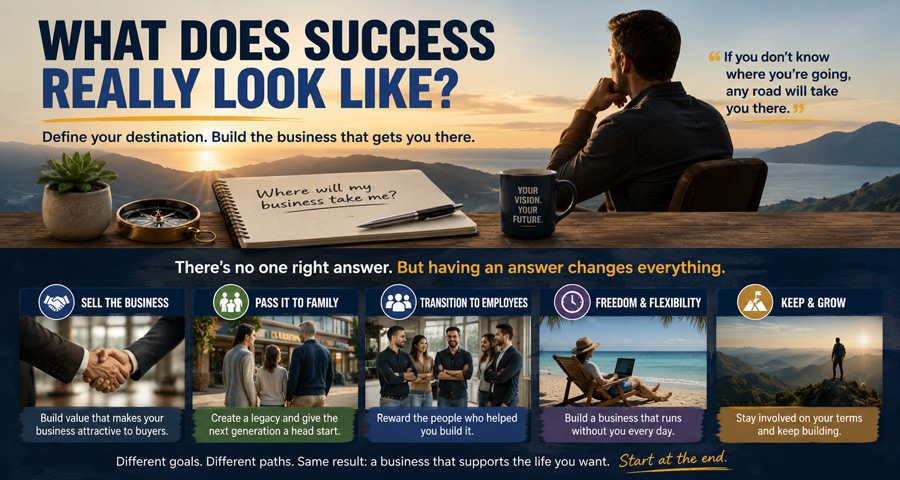
Before you spend years building your business, take a few minutes to picture what success actually looks like for you. Not what success looks like to your neighbor, your competitor, or the latest business guru on YouTube. What does success look like in your life?
Maybe your dream is to build a company that you can eventually sell for enough money to retire comfortably. Perhaps you’d like your children to take over someday and continue what you’ve built. You may want to hire a great management team so the business runs successfully while you spend more time traveling, volunteering, or simply enjoying life. There isn’t one correct answer because every entrepreneur has different goals.
The important part is having a destination. Every major decision you make should move you closer to that vision. If your goal is eventually selling the business, you’ll build systems differently than someone who plans to hand it to their children. If your goal is freedom, you’ll focus on delegation much sooner than someone who enjoys being involved in every detail.
Too many business owners spend years climbing the ladder only to discover it was leaning against the wrong building. Taking the time to define success now makes it far less likely you’ll arrive somewhere you never intended to go.
Businesses Have Endings—That’s Not a Bad Thing
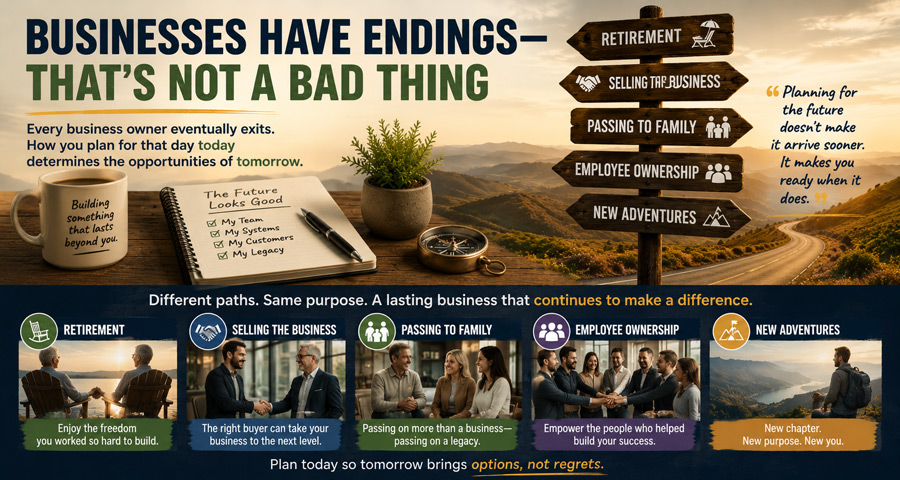
Every business owner eventually exits their business. That isn’t a prediction; it’s simply reality. Some owners retire after decades of hard work. Others sell when the right opportunity presents itself. Some pass the company to family members, while others transition ownership to trusted employees or business partners.
Life also has a way of introducing changes we never planned for. Health challenges, family priorities, or unexpected opportunities can alter our direction in ways we couldn’t have imagined when we first opened our doors. Planning for those possibilities isn’t pessimistic. It’s responsible stewardship of something you’ve worked incredibly hard to build.
Let’s be honest for a moment. Most entrepreneurs have trouble taking a weekend off without checking their email. Thinking about retirement can feel downright uncomfortable when you’re still excited about growing your business. Fortunately, planning for an eventual exit doesn’t mean you’re slowing down. It simply means you’re building something that will continue to have value long after you’ve moved on to your next adventure.
A well-planned ending is actually one of the greatest compliments you can pay your business. It means you’ve built something strong enough to continue serving customers, supporting employees, and creating value without depending entirely on you.
Decisions Compound Over Time
One lesson I’ve learned over the years is that business decisions have a remarkable way of compounding. Small choices rarely stay small. They either create momentum that moves your business forward or they slowly become obstacles you’ll eventually have to overcome.
The employee you hire today may become the person who runs the company twenty years from now. The accounting system you choose today may determine how easily a future buyer can understand your financial records. The procedures you document today become the training manuals that help future employees maintain the quality your customers expect.
The same principle applies to your customers. A business built on recurring relationships is generally worth far more than one that depends on constantly finding new clients every month. Investing in systems, documenting processes, and developing dependable leadership may not feel exciting, but those decisions quietly increase the value of your business year after year.
That’s why I encourage entrepreneurs to think beyond today’s problems. Ask yourself whether the decision you’re making today will still look like a smart decision ten years from now. If the answer is yes, you’re probably building the kind of business that creates lasting value instead of temporary success.
Begin With the Destination
You don’t need a detailed twenty-five-year roadmap before opening your business. Markets change, technology evolves, and life has a habit of rewriting even the best plans. What you do need is a clear sense of direction that helps guide your decisions when opportunities and challenges inevitably appear.
When you know your destination, it’s easier to recognize distractions disguised as opportunities. Every shiny object no longer deserves your attention because you’ve already defined what success looks like. That clarity saves time, reduces expensive mistakes, and helps you focus your energy where it will have the greatest long-term impact.
I’ve watched business owners spend decades working harder than they ever imagined, only to discover they created a business they couldn’t sell, couldn’t step away from, and couldn’t easily pass to someone else. I’ve also seen owners build companies that became valuable assets because they intentionally planned for the future from the very beginning. The difference wasn’t intelligence, luck, or even hard work. The difference was direction.
That’s why I continue to tell entrepreneurs to start their business at the end. Not because I’m encouraging them to think about leaving, but because I’m encouraging them to build something worth leaving behind.
Key Takeaways
- Define what success looks like before you begin building your business.
- Remember that every business eventually changes ownership in one form or another.
- Make decisions that increase the long-term value of your company, not just this month’s revenue.
- Build systems that allow the business to succeed without depending entirely on you.
- Focus on creating an asset that gives you choices instead of a job that demands your constant attention.
- Start your business at the end so every important decision moves you closer to the future you want.
Keep Asking. Keep Learning.
The best business owners never stop learning because they understand that every good decision begins with good information. If this article gave you a new perspective, I invite you to download the companion infographic and subscribe to the Always Seek Knowledge newsletter.
Each week, you’ll receive practical business insights, downloadable guides, checklists, and real-world advice designed to help you build a stronger business with greater confidence. We don’t believe in filling your inbox with fluff, and we will never sell or share your email address.
Whether you’re launching your first company or preparing to pass your business to the next generation, our goal is simple: help you make better business decisions, one question at a time.
ASK. Learn. Connect. Grow.