
Your Team Is Watching What You Tolerate

Every business has rules. Some are written in employee handbooks, posted on breakroom walls, or explained during orientation. Others exist only in the owner’s head. But there is another set of rules that may be far more powerful than anything you’ve written down: the behaviors you allow to continue.
You can tell employees that customers come first. You can talk about teamwork, professionalism, respect, accountability, and doing quality work. You can even have those words printed on an impressive poster hanging next to the coffee machine. But if one employee continually treats customers poorly and nothing happens, another regularly arrives late while everyone else manages to arrive on time, and someone else refuses to help coworkers because “that’s not my job,” your team begins receiving a very different message.
They’re not simply watching the employee who is causing the problem. They’re watching you. Every time unacceptable behavior continues without being addressed, you’re quietly teaching everyone what the real rules of your business are.
Culture Isn’t What You Put on the Wall
Business owners sometimes think of company culture as something they create intentionally. They develop mission statements, establish company values, organize employee events, and talk about the kind of workplace they want to build. Those things can certainly help, but culture isn’t created by statements alone. It develops through hundreds of small interactions that happen every week and, more importantly, through the way leadership responds to those interactions.
Imagine that one of your stated company values is respect. Most employees treat one another professionally, but you have one person who regularly interrupts coworkers, talks down to new employees, and occasionally loses their temper. Everyone knows it happens, including you, but this employee is productive. Maybe they’re your best salesperson, your most experienced technician, or the only person who understands some complicated part of the business. Correcting the behavior feels uncomfortable, and the thought of replacing them feels even worse, so you let things slide.
Your employees have now learned something important about the company: respect matters unless you’re valuable enough to get away with being disrespectful. That probably isn’t the culture you intended to create, but intentions don’t carry nearly as much weight as actions. What leadership repeatedly permits eventually becomes an accepted part of the workplace.
Employees Pay Attention to What Happens Next

Employees don’t expect perfection from their coworkers, and most don’t expect perfection from their bosses. People have bad days. Someone occasionally shows up late, a deadline gets missed, tempers flare, and mistakes happen. A healthy organization understands the difference between being human and developing a pattern of behavior that affects everyone around you.
What employees pay attention to is what happens afterward. Does the problem get acknowledged? Does someone have the difficult conversation? Is there an expectation that the behavior changes, or does everyone simply pretend nothing happened because addressing it would be awkward?
Employees are constantly gathering information about how an organization actually operates. They notice who gets corrected and who doesn’t. They notice whether deadlines really matter, whether poor customer service has consequences, and whether the boss follows the same standards expected of everyone else. Over time, those observations become the unofficial employee handbook. Nobody has to write it down because everyone eventually understands the real rules.
This is one reason inconsistency can be so damaging to workplace culture. If one employee is corrected for being late while another is routinely allowed to wander in whenever they please, employees don’t see flexibility; they see favoritism. Even when there is a perfectly reasonable explanation, failing to address obvious inconsistencies can cause people to create their own explanation, and theirs probably won’t be nearly as generous as yours.
Your Best Employees Notice First
One of the greatest dangers of tolerating poor behavior is that the employees most likely to become frustrated by it are often the employees you most want to keep. Good employees generally don’t need constant supervision. They show up, do their work, help customers, solve problems, and contribute to the team. Because they’re dependable, it’s easy for managers to spend most of their attention dealing with employees who aren’t.
Consider two people doing similar jobs. One consistently arrives on time, meets deadlines, helps coworkers, and rarely creates problems. The other regularly arrives 15 minutes late, disappears for extended breaks, and leaves unfinished work for someone else. If both continue receiving the same paycheck and the same treatment from management, eventually the dependable employee begins wondering why they’re putting in the extra effort.
At first, that frustration may not be obvious. The employee might simply stop volunteering to help. Maybe they stop staying an extra ten minutes to finish something or stop pointing out problems they used to solve without being asked. Eventually, they may decide that another employer would appreciate their effort more than you do.
Now you’ve accomplished something no business owner wants to accomplish: you’ve lost the person who was doing the job correctly while keeping the person who created the problem. That’s an expensive price to pay for avoiding an uncomfortable conversation.
Avoiding Conflict Doesn’t Eliminate Conflict

Many small business owners dislike confrontation, which is understandable. Most people didn’t start businesses because they dreamed of someday telling an employee that their attitude stinks. Owners often begin as salespeople, craftspeople, technicians, consultants, or professionals. Then the business grows, employees arrive, and suddenly part of the job involves conversations nobody particularly enjoys having.
Avoiding those conversations can feel easier in the moment, but avoiding conflict doesn’t make the problem disappear. It simply moves the conflict somewhere else. Instead of having one uncomfortable conversation between a manager and an employee, you create dozens of smaller frustrations among everyone working around that person.
Employees begin complaining to each other. Resentment grows. People start doing less because they see others getting away with doing less. Good employees stop volunteering for extra responsibility because they’ve learned that extra effort isn’t particularly valued. Before long, the behavior of one difficult employee has begun changing the behavior of people who weren’t difficult employees when the problem started.
This is where an employee problem becomes a culture problem. Leadership sometimes means accepting a little discomfort today so you don’t inherit a much larger problem tomorrow.
Accountability Doesn’t Mean Becoming a Tyrant
Talking about accountability can make leadership sound harsher than it needs to be. None of this means you should walk through the office looking for violations and handing out punishments like parking tickets. If employees are afraid that every mistake will result in a lecture, you’ll create an entirely different culture problem.
Good leadership requires judgment. There’s an enormous difference between someone who makes an occasional mistake and someone who repeatedly ignores expectations. Employees should have room to learn, experiment, make reasonable mistakes, and occasionally have a rough day without worrying that the boss is keeping a permanent scorecard.
Accountability simply means expectations actually mean something. When there’s a problem, address it while it’s still small. Explain what you observed, why it matters, what you expect going forward, and then give the employee an opportunity to correct it. In many cases, the employee may not fully realize how their behavior is affecting other people.
A short conversation today can prevent a very unpleasant conversation six months from now. It can also be much fairer to the employee. If you’ve quietly tolerated a behavior for a year and suddenly explode because you can’t stand it anymore, the employee may reasonably wonder why something that was apparently acceptable yesterday has become a major offense today.
Consistency Matters More Than Toughness
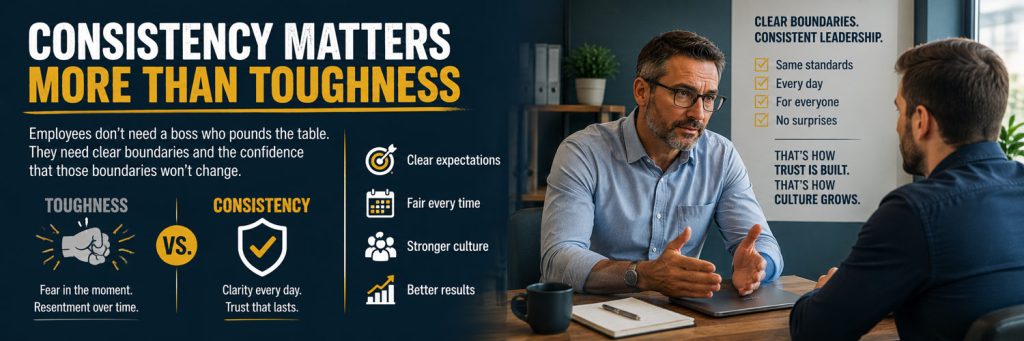
Some managers hear the word accountability and assume they need to become tougher. In reality, consistency is usually more important than toughness. Employees don’t need a boss who pounds the table. They need to understand where the boundaries are and have confidence that those boundaries won’t move depending on the day, the employee, or the boss’s mood.
This means responding to similar situations in similar ways while still allowing room for individual circumstances. Someone who arrives late because their car wouldn’t start isn’t the same as someone who arrives late three times a week because they simply don’t care about the schedule. Leadership requires enough common sense to recognize the difference without turning every policy into a courtroom proceeding.
Consistency also builds trust because employees know where they stand. They don’t have to guess whether today’s rule will still be the rule tomorrow. Over time, clear and reasonable expectations actually reduce the amount of correction a leader has to do because the team begins reinforcing the culture itself.
That’s when you’ve moved beyond managing individual behavior and started building an organization.
The Rules Apply to You Too
Perhaps the hardest part of this discussion is recognizing that employees aren’t only watching what you tolerate from other people. They’re watching what you tolerate from yourself. If employees are expected to arrive on time but the owner routinely wanders in late, people notice. If employees are expected to treat customers respectfully but the boss complains about customers in front of the staff, people notice that too.
The same thing happens with communication. You might tell employees that evenings and weekends belong to their families, then send emails at 11:30 at night and become irritated when nobody answers until morning. The written rule may say one thing, but your behavior is teaching something completely different.
Leadership doesn’t require perfection. It does require awareness and a willingness to acknowledge when you’ve fallen short of your own expectations. In fact, one of the strongest things a leader can do is simply admit, “I handled that badly. I’ll do better next time.”
Owning a mistake doesn’t weaken your authority. When done sincerely, it strengthens your credibility because you’ve demonstrated the same accountability you’re asking from everyone else.
What Are You Tolerating Right Now?

Here’s a useful leadership exercise. Think about the things happening in your business that regularly irritate you. Maybe meetings always start ten minutes late. Perhaps paperwork doesn’t get completed, employees constantly check their phones while customers are present, or one person dominates every conversation. Maybe departments blame each other whenever something goes wrong, or perhaps you’ve been complaining about the exact same employee behavior for the last six months.
Instead of asking why people keep doing these things, ask a more difficult question: Why am I continuing to allow them?
Sometimes there will be a legitimate answer. Perhaps you haven’t communicated the expectation clearly. Maybe an employee needs additional training, or the process itself is poorly designed. You might even discover that the rule you’re trying to enforce doesn’t make much sense anymore and needs to be changed.
But sometimes the answer is much simpler: addressing the problem feels uncomfortable, so you’ve been hoping it will somehow correct itself.
That’s when leadership has to take over. You don’t need to become angry, dramatic, or intimidating. You simply need to be willing to have the conversation and establish what happens next.
Your Actions Write the Real Employee Handbook
Employees listen to what leaders say, but they learn much more from what leaders consistently do. Every time you recognize good work, you’re communicating something about your culture. Every time you correct inappropriate behavior, you’re communicating something. Every time you ignore a problem because dealing with it would be inconvenient, you’re communicating something then too.
This happens gradually, which is why leaders sometimes don’t recognize a culture problem until it has become deeply established. There usually isn’t a single Tuesday afternoon when the workplace suddenly develops a bad culture. Instead, small behaviors are tolerated, repeated, and eventually accepted. What once irritated everyone slowly becomes “just the way things are around here.”
The good news is that culture can develop in the opposite direction too. When leaders consistently recognize good work, address problems early, communicate expectations clearly, and hold themselves to those same expectations, employees begin learning a different set of unwritten rules. They learn that effort matters, respect matters, customers matter, and people can make mistakes without being allowed to repeatedly create problems for everyone else.
Great workplace cultures aren’t built through inspirational posters, company picnics, or carefully worded mission statements alone. They’re built through thousands of small leadership decisions made over months and years. Some of those decisions are easy, while others require conversations you’d rather not have.
Your team is watching all of them, and what you tolerate today may become the culture you’re managing tomorrow.
Key Takeaways
- Your real company standards are demonstrated by what you consistently allow, not simply by what you’ve written down.
- Ignoring poor behavior can unintentionally punish employees who are doing things correctly.
- Avoiding an uncomfortable conversation today can create a much larger culture problem later.
- Accountability doesn’t require harsh management; it requires clear expectations and consistent follow-through.
- Consistency is more valuable than toughness because employees need to understand where the boundaries are.
- Leaders must apply standards to themselves as well as their employees.
- If a problem keeps happening, ask whether you’ve unintentionally taught people that it’s acceptable.
Keep Asking. Keep Learning.
Strong leadership isn’t about having a perfect team or never making mistakes. It’s about paying attention to what’s happening around you, asking difficult questions, and being willing to address problems before they become accepted parts of your culture.
Take a look around your business this week and ask yourself one question: What behavior am I tolerating today that I wouldn’t want to become normal tomorrow? The answer may point directly toward the leadership conversation you’ve been avoiding.
Continue building your business knowledge with Always Seek Knowledge. Sign up for the ASK newsletter for practical ideas you can put to work in your business, and download the free PDF version of this article to keep, share with your leadership team, or use to start a conversation at your next meeting.
Keep Asking. Keep Learning.