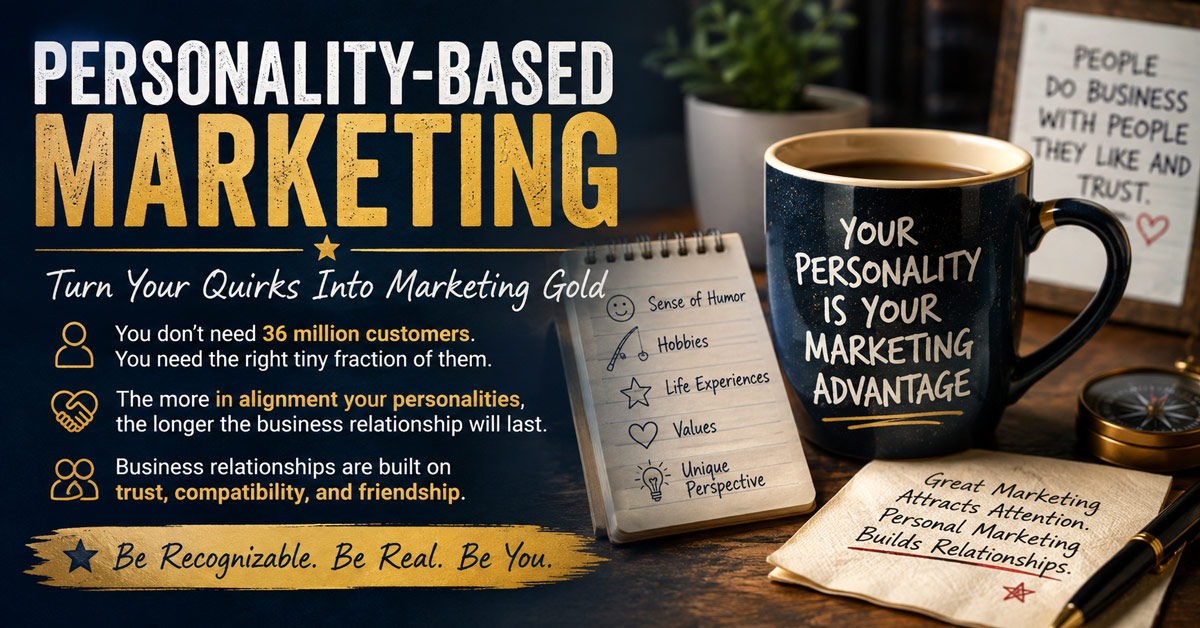
Personality-Based Marketing: Turn Your Quirks Into Marketing Gold
For years, small business owners have been told that good marketing should look professional, polished, and carefully controlled. We choose the right photographs, clean up our language, avoid saying anything too unusual, and sometimes even try to make our companies look bigger than they really are. Somewhere along the way, we can polish away the very thing that makes a small business interesting: the person behind it.
I think there’s a better approach.
What if some of the things you’ve been trying to hide are actually marketing advantages? Your sense of humor, hobbies, unusual experiences, favorite stories, strong opinions about your profession, or slightly odd way of looking at the world may give potential customers a reason to remember you. More importantly, those things may help the right customers recognize someone they would genuinely enjoy doing business with.
I call this Personality-Based Marketing, and the idea is pretty simple: instead of trying to create marketing that appeals to everyone, create content that naturally attracts people who are compatible with you.
Your little quirks might just be marketing gold.
What Is Personality-Based Marketing?
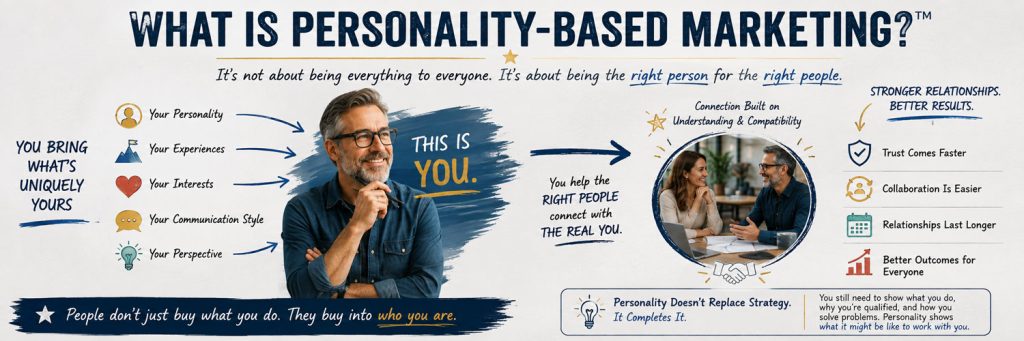
Personality-Based Marketing™ is the intentional use of your authentic personality, experiences, interests, communication style, and perspective to help the right customers connect with you. It doesn’t replace traditional marketing. Customers still need to understand what you do, whether you’re qualified, and how you can solve their problems. Personality simply gives them another important piece of information: what it might actually be like to work with you.
Look at the average small-business website and you’ll quickly understand why this matters. We’re all “committed to excellence.” We all provide “outstanding customer service.” Our people are “experienced professionals,” and our solutions are apparently always “tailored to meet the unique needs of our clients.” None of those things are bad, but we’ve repeated them so often that they’ve become nearly invisible.
Now imagine finding a business owner who talks about lessons learned from restoring old cars, coaching Little League, serving in the military, playing drums in a jazz band, raising children, running marathons, rebuilding a house, or making one spectacularly bad business decision twenty years ago. Suddenly, there’s a human being behind the company.
That changes how we respond to the marketing because people don’t develop relationships with logos. They develop relationships with people.
You Don’t Need Everybody
According to the U.S. Small Business Administration, there are more than 36 million small businesses in the United States. If you primarily sell to businesses, that number should make you stop worrying about whether everybody likes your marketing.
Think about how many customers you could actually serve. A consultant might only need twenty or thirty excellent clients. A commercial contractor could build a very successful business serving a relatively small group of repeat customers. An accountant might serve a few hundred companies. Even a growing agency would have difficulty maintaining meaningful relationships with more than a tiny fraction of America’s businesses.
You don’t need millions of customers. You probably don’t even need thousands.
Once we understand that, the marketing question changes. Instead of asking, “How do I create marketing that appeals to as many people as possible?” we can ask, “How do I make it easier for the people who would naturally enjoy doing business with me to recognize me?”
That is the heart of Personality-Based Marketing™.
Personality Is a Filter, Not Just a Magnet
Business owners sometimes hesitate to show personality because they’re afraid someone won’t like them. They’re absolutely right. Someone probably won’t.
If you have a dry sense of humor, somebody isn’t going to get the joke. If you’re extremely analytical, somebody may think you provide far too much information. If you’re casual and conversational, someone looking for a highly formal corporate relationship may decide you aren’t the right fit. The natural response is to remove those characteristics from our marketing so we don’t risk turning anyone away.
But perhaps turning a few people away isn’t such a terrible thing.
Marketing shouldn’t only help customers discover your business. It should help both sides determine whether working together makes sense. When your personality is visible in your content, potential customers gradually learn how you think, communicate, solve problems, and interact with people. By the time they finally call, they may already have a pretty good idea of whether they would enjoy working with you.
In that sense, personality becomes both a magnet and a filter. It attracts people who appreciate your style while quietly helping incompatible customers continue looking. That can save everyone a lot of frustration.
Business Relationships Are Still Human Relationships
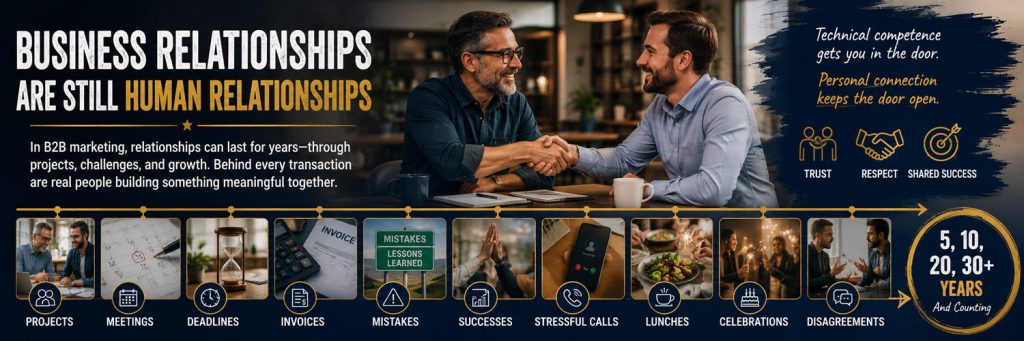
This becomes particularly important in B2B marketing because business relationships can last a very long time. You might work with the same customer for five, ten, twenty, or even thirty years. Over that time there will be projects, meetings, deadlines, invoices, mistakes, successes, stressful phone calls, lunches, celebrations, and probably a few disagreements.
Technical competence may get you into the relationship, but personal compatibility helps you stay there.
Think about the customers you’ve worked with the longest. Chances are you know more about them than what’s written in your CRM. You know about their families. You know their hobbies. You know when they’re having a bad day. You know which jokes they’ll laugh at and which subjects will get them talking for twenty minutes. Eventually, you stop thinking of some of these people strictly as customers.
They’re friends who also happen to do business with you.
That friendship matters because when people genuinely enjoy working together, there’s usually more patience when something goes wrong, better communication when difficult decisions need to be made, and a greater willingness to find solutions instead of looking for someone to blame. Competitors will still come knocking, but replacing a vendor is much easier than replacing a trusted friend.
That’s why personality alignment can have enormous long-term business value.
Stop Hiding the Interesting Parts
Imagine two accountants who have nearly identical qualifications. Both have twenty years of experience. Both provide bookkeeping, payroll, tax preparation, and business advisory services. Their pricing is comparable, and their offices are only a few miles apart.
The first accountant’s website says something like, “Our experienced team provides comprehensive accounting solutions tailored to meet the unique needs of today’s businesses.” It’s professional, accurate, and completely safe. Unfortunately, it could probably appear on ten thousand accounting websites without anyone noticing.
The second accountant loves fishing and writes an article called, “Five Things Fishing Taught Me About Managing Cash Flow.” He tells a funny story about spending too much money on fishing gear, connects patience on the water to managing seasonal cash flow, and explains a few practical financial lessons along the way.
Now I know something about him.
If I love fishing too, we immediately have something to talk about. Even if I’ve never held a fishing rod in my life, I may enjoy the story and remember the financial lesson. Most importantly, I now have some idea of who this person is. If his personality appeals to me, I’m one step closer to calling him.
He didn’t become less professional by talking about fishing. He became more human.
Your Life Is Full of Marketing Content
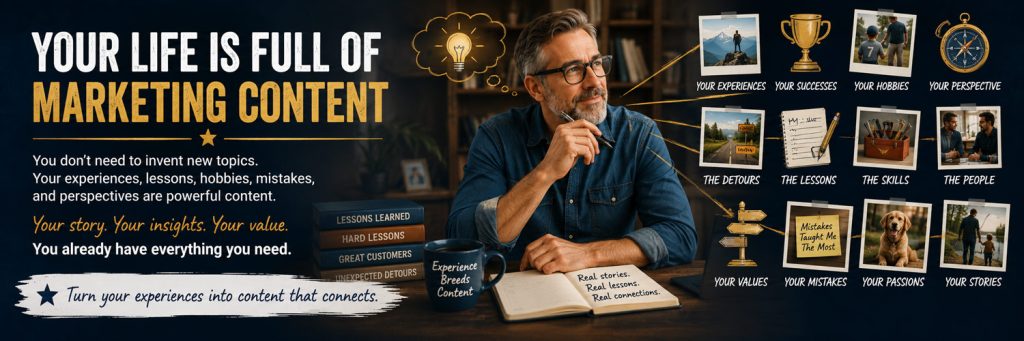
One of the reasons business owners struggle to create content is that they think they need to continually invent new subjects. Personality-Based Marketing changes that because you already have decades of material sitting in your memory.
Your experiences are content. So are your mistakes, hobbies, successes, failures, observations, unusual jobs, mentors, customers, and lessons learned the hard way. Even the strange little habits your friends tease you about can become useful material when they’re connected to something your customers need to understand.
Maybe gardening taught you patience. Restoring an old car taught you the importance of preventative maintenance. Playing in a band taught you that five talented people aren’t necessarily a team. Coaching youth sports taught you how differently people respond to criticism. Military service shaped the way you approach planning. Raising children changed the way you communicate with employees.
The point isn’t to turn your business website into a personal diary. The customer still needs to get something useful from the story. Personality provides the doorway, but knowledge is what makes walking through that doorway worthwhile.
That’s where your quirks become marketing gold. You’re taking something uniquely yours and using it to explain something valuable to someone else.
Don’t Manufacture a Marketing Personality
There is an important difference between showing your personality and creating a character you think people will like.
If you’re naturally quiet and thoughtful, you don’t need to become the loudest person on YouTube. If you’re serious, you don’t suddenly need to become a comedian. If you hate being on camera, there’s no reason to start dancing on social media because somebody told you that’s what successful businesses do now.
Personality-Based Marketing works because the personality is real.
The goal is to make your marketing sound and feel more like the person a customer will eventually meet. If someone reads your articles for six months and finally sits down across the table from you, there shouldn’t be a dramatic difference between the two versions of you.
Ideally, they’ll walk away from that first meeting thinking, “That’s exactly who I thought this person would be.”
That’s a pretty good indication your marketing is doing its job.
Smaller Audiences Can Build Bigger Relationships
Modern marketing has developed an understandable obsession with numbers. We measure followers, views, impressions, subscribers, clicks, traffic, reach, and engagement. Those numbers can be useful, but they can also cause small businesses to chase an audience they don’t actually need.
Suppose 100,000 people see your content every month, but almost none of them own businesses you could serve. Compare that with an audience of 500 people who understand what you do, appreciate your perspective, enjoy hearing from you, trust your judgment, and regularly recommend you to others.
I’ll take the 500.
For most small businesses, becoming famous isn’t the goal. Becoming known by the right people is far more valuable. A relatively small audience filled with people who trust you can generate an extraordinary amount of business over twenty or thirty years.
This is particularly true when your marketing allows those relationships to begin before the first conversation.
Someone might read your articles for a year before contacting you. They may receive your newsletter every Monday morning, follow your social media posts, listen to your podcast, or watch your videos without ever commenting. From your perspective, they are an anonymous website visitor. From their perspective, however, they’ve been getting to know you for months.
Then something changes. They need the service you provide.
When the phone rings, you may be speaking with them for the first time, but they don’t necessarily feel like they’re speaking with a stranger. They already understand something about your personality, philosophy, experience, and approach.
That’s a very different place to begin a sales conversation.
You Are Not Trying to Win a Popularity Contest
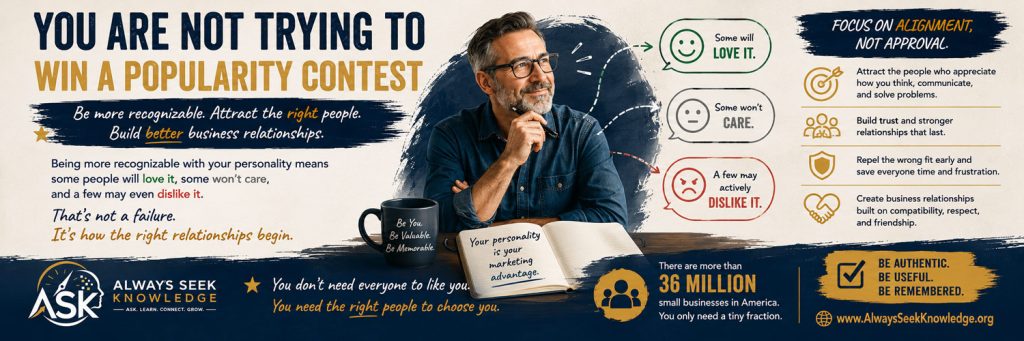
Perhaps the hardest part of Personality-Based Marketing is accepting that being more recognizable means giving people something to have an opinion about. Some will love your approach. Others won’t care. A few may actively dislike it.
That’s okay.
There are more than 36 million small businesses in America, and you couldn’t possibly work with more than a tiny fraction of them. There is no practical reason to spend your marketing energy trying to become acceptable to every one of them.
Be knowledgeable. Be helpful. Be professional. Treat people with respect and deliver what you promise. But don’t confuse professionalism with being bland.
Tell your stories. Share what you’ve learned. Talk about your interests when they help make a point. Let your humor sneak into an article occasionally. Explain why you believe something rather than simply telling people what they should do.
Give prospective customers enough information to decide not only whether you can do the job, but whether they would enjoy doing the job with you.
Because the strongest B2B relationships aren’t always created between two companies that happen to find each other. They’re often created between two people who begin doing business together, discover that their personalities naturally fit, and eventually become friends.
Those relationships don’t always last for one project.
Sometimes they last for decades.
Key Takeaways
Personality-Based Marketing doesn’t mean making yourself the center of every article, video, or social media post. Your customer and their needs should remain at the center of your marketing. Your personality simply gives people another way to understand you and decide whether you’re the kind of person they want helping them solve those problems.
You don’t need everyone to like you. You need enough of the right people to know you, trust you, and enjoy working with you. Showing more of your authentic personality can make that easier because it turns an otherwise anonymous business into someone customers can recognize and remember.
Take another look at your marketing and ask yourself a simple question: If someone removed my company name and logo from my website, would anything about the content tell them it belonged to me?
If the answer is no, you may be hiding one of your most valuable marketing assets.
Yourself.
Keep Asking. Keep Learning.
The next time you sit down to create an article, newsletter, video, or social media post, don’t immediately ask yourself what a business is supposed to say. Think about something you’ve experienced, something you enjoy, or a lesson you’ve learned that might help someone else understand the subject differently.
You may discover that the little quirks you’ve spent years keeping out of your professional marketing are exactly what make people remember you.
Want more practical ideas for building a stronger business? Sign up for the Always Seek Knowledge newsletter and get new articles, ideas, and resources delivered directly to you.
Ready to put Personality-Based Marketing to work? Download the free PDF companion to this article and start identifying the experiences, interests, stories, and quirks that could become part of your own marketing strategy.